
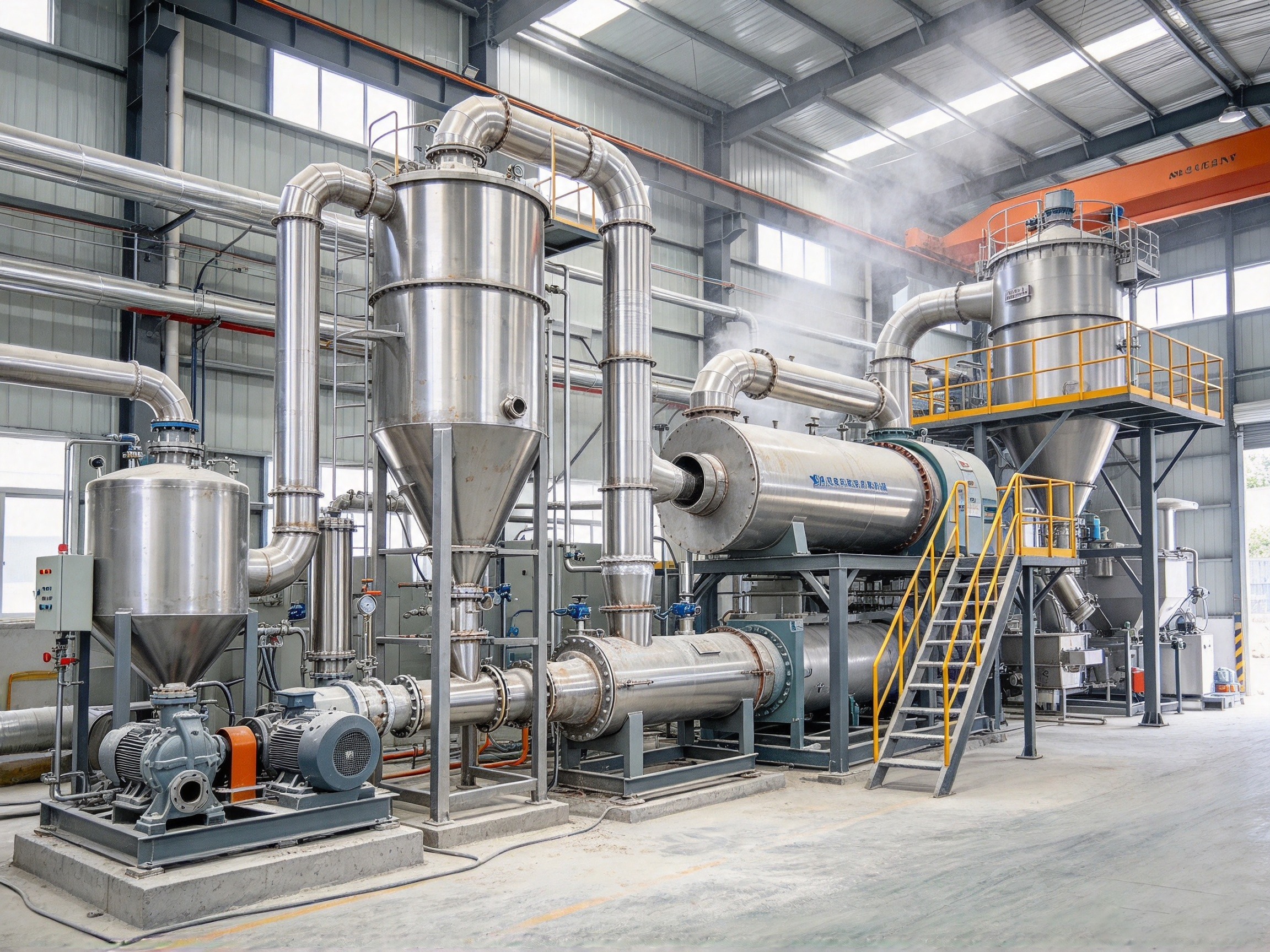
Spray drying converts a liquid, whether milk, creamer emulsion, egg liquid, coffee extract or a chemical slurry, into free-flowing powder in one continuous operation. It is the heart of every dairy creamer line and most fat powder plants, and usually the single most expensive machine in such a line. Buyers who understand the basics of spray dryer engineering ask better questions, compare offers on real parameters, and avoid the two classic failures: a dryer that cannot reach capacity, and a powder that will not dissolve.
This guide explains in buyer’s terms how a spray dryer is sized, what determines powder quality, and where the real cost drivers sit in a complete drying line.
What actually happens inside the tower
A spray dryer has four functional zones. First, the liquid feed is atomized into millions of fine droplets by a high-pressure nozzle or a rotating atomizer wheel. Second, hot filtered air mixes with the droplets and water evaporates within seconds as each droplet becomes a particle. Third, particles and air are separated: most powder falls to the tower cone while fines are recovered in cyclones or a bag filter. Fourth, the powder is cooled and conveyed to sieving and packing.
Everything a buyer cares about, solubility, bulk density, particle size distribution and moisture content, is set by decisions in those four zones: atomization method, inlet and outlet air temperatures, air flow pattern (co-current or counter-current), and particle residence time in the tower.
Nozzle or atomizer wheel?
Pressure nozzles produce coarser, denser particles and are common for fat powders and creamers where free flow and bulk density matter. Atomizer wheels handle high-viscosity and abrasive feeds more gracefully and give finer particles. The choice depends on the product family: non-dairy creamer and fat powders typically use nozzle towers engineered around the emulsion’s solids and fat loading, where particle structure and free-flow behavior are the quality battleground; milk powders and whey-based products exist in both configurations, with large dairy lines often using wheels for capacity and flexibility; multi-product plants pay more up front for changeable atomization and flexible air handling, which protects them when the product mix evolves, a common story in growing food companies.
Sizing: why evaporation capacity is the number that matters
Spray dryers are sized by evaporation capacity, kilograms of water removed per hour, not by tons of powder per day. The same tower produces different powder outputs depending on feed solids: raising feed solids from 45% to 55% increases powder output dramatically while the tower stays the same size. This is why emulsification and concentration equipment upstream of the dryer is not an accessory; it is the cheapest way to add capacity to the whole line.
When comparing quotations, normalize every offer to evaporation capacity at your actual feed solids and check the assumed inlet and outlet temperatures. A tower quoted at optimistic temperatures will either dry your product or fail to, depending on how far those assumptions sit from the product’s real behavior.
The line around the tower
A spray dryer never works alone. In a complete creamer or fat powder line it is surrounded by dosing and mixing that disperses powder ingredients and fats into a stable emulsion; homogenization that fixes droplet size and later determines free fat and wettability; feed pre-treatment and filtration protecting the nozzle or wheel and the powder’s appearance; a fluid bed after-dryer and cooler, where two-stage drying improves solubility and prevents caking in the bag; and sieving, magnetic separation and packing that protect the powder the customer finally receives. Buyers who evaluate the tower in isolation often discover that integration problems appear in the upstream and downstream equipment that was quoted casually or omitted entirely. A turnkey supplier sizes the whole line around the product, not the other way round.
Hygiene, materials and documentation
For food duty, product-contact surfaces are stainless steel with an appropriate finish; the tower interior, ducts and cyclones must be cleanable, so CIP coverage is a legitimate comparison point between offers. Welding quality inside the tower is invisible after commissioning but determines cleaning performance for the life of the machine, which is why factory inspection and FAT before shipment matter. Export-bound equipment should be engineered against the machinery-safety and pressure-equipment requirements of the destination country; ask explicitly which standards the machine is designed to, and get the answer in writing.
Five questions to bring to any spray dryer supplier
Close your inquiry with five questions, and the quality of the answers will tell you more than any brochure: what evaporation capacity do you guarantee at our feed solids, and at which temperatures; which atomization type do you recommend for our product family and why; can we visit a reference line running a comparable product and see it operating; what is included beyond the tower, covering feed preparation, fluid bed, fines return, CIP and controls; and who installs, commissions and trains our operators, and for how long are technicians available on site.
Our answer to the last question is one of our strongest arguments: after commissioning, technicians can stay on site for six to twelve months until your team runs the plant independently. If you are planning a creamer, fat powder or dairy powder project, send us your product and target capacity; we will size the line and show you the economics.