
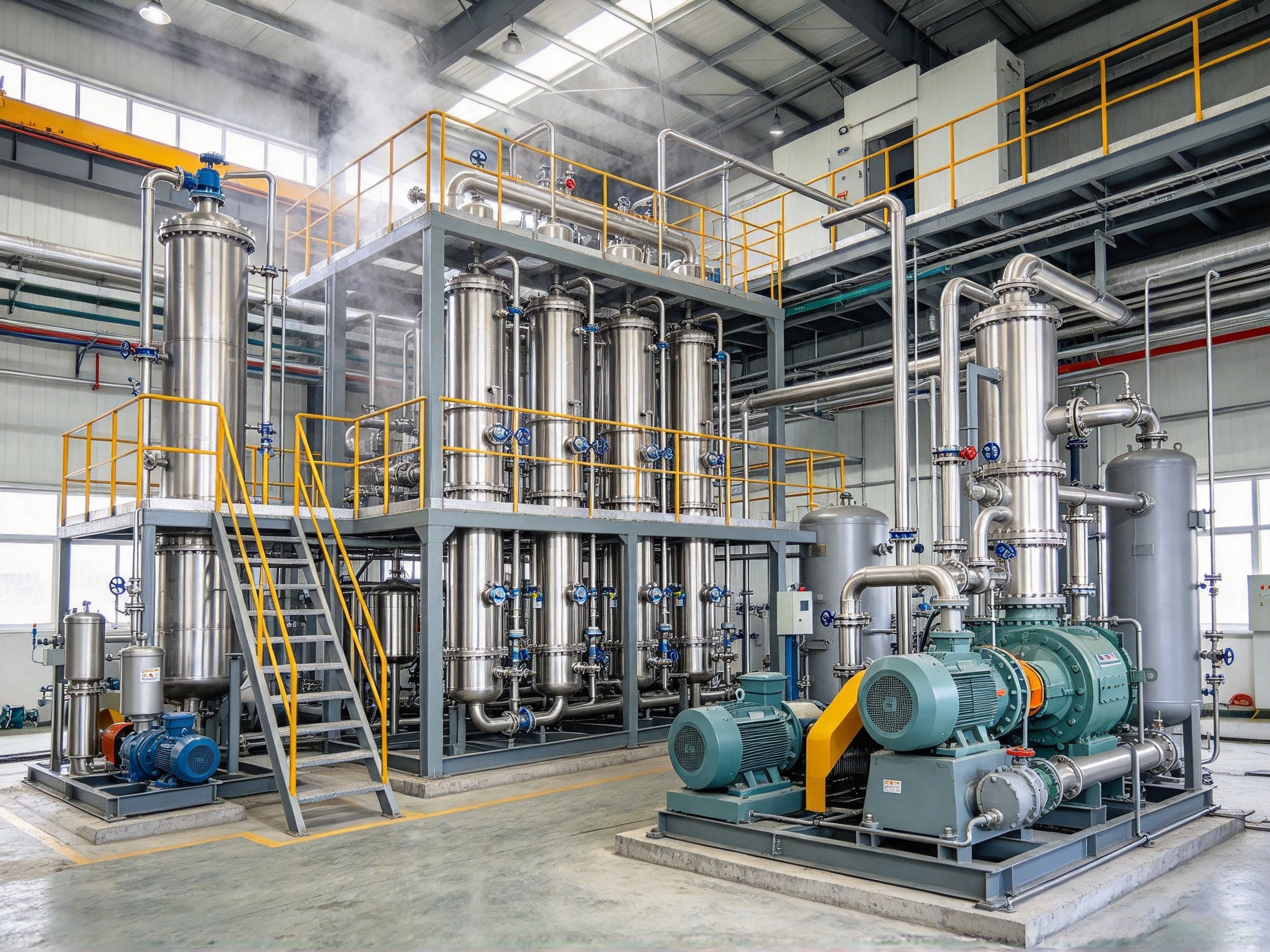
Evaporation is one of the most energy-hungry operations in a food, starch, dairy or chemical plant. Whether you are concentrating glucose syrup, milk, fruit juice or wastewater, the energy cost of removing every ton of water shows up in the plant’s operating profit for decades. The choice between a mechanical vapor recompression (MVR) evaporator and a multi-effect evaporator (MEE) therefore deserves more analysis than it usually receives during a quotation comparison.
Both technologies do the same job: they boil water or solvent out of a product to raise its solids content. The difference lies in how each reuses the energy in the vapor it generates, and that difference decides which system costs less at your specific site.
How the two systems work
A multi-effect evaporator is a train of several vessels, called effects. Live steam heats the first effect; the vapor boiled off the product then heats the second effect at a lower pressure, and so on down the train. Each effect reuses the heat of the previous one, which is why a three- or four-effect system needs far less live steam than a single-effect unit. The technology is mature, robust and familiar to plant operators everywhere.
An MVR evaporator takes a different route. The vapor from the product is compressed by a mechanical compressor, usually a fan or turbo compressor, which raises its pressure and temperature just enough to make it usable as heating steam again. In steady operation almost all evaporation energy is recycled inside the system, with electrical power driving the compressor. Steam consumption falls to the small quantity needed for start-up and make-up, and running cost is dominated by electricity.
The deciding factors: energy prices at your site
In practice the choice is an energy-arithmetic problem. Three questions about the site need answers first: what a ton of steam costs and how stable steam supply is; what a kWh of electricity costs and whether the power supply is reliable enough for a compressor motor; and how many tons of water are evaporated per hour and per year.
When steam is expensive and electricity is cheap and stable, MVR almost always wins on running cost, and the higher compressor investment pays back within a few years. When steam is cheap, for example at a site with its own coal, biomass or waste-heat boiler, a multi-effect line can be the more economical choice, with a simpler machine train and lower electrical demand.
Evaporation duty matters as well. The larger the continuous load, the faster MVR’s energy savings accumulate. For small, batch-type or highly intermittent duty, the economics shift back toward multi-effect systems.
Product behavior: the second filter after economics
Not every product tolerates both systems equally. Falling-film evaporators, the workhorse in both configurations, need the product to form a uniform film on the tube wall. High viscosity, high boiling-point rise or strong fouling tendency changes the calculation. High boiling-point rise products such as high-solids sugar syrups and certain effluents reduce the effective temperature difference per effect, increasing the heating area an MEE requires and eroding its steam economy. Fouling products require frequent cleaning, so the layout must provide access and, in serious cases, switchable calandrias; this applies to both systems, but cleaning downtime weighs more heavily on MVR because MVR favors long continuous runs. Heat-sensitive products such as dairy and fruit components push the design toward low temperature differences and vacuum operation, achievable in both systems but with different control behavior that should be reviewed case by case.
This is why a serious evaporator supplier asks for product data, Brix or solids curve, viscosity, fouling behavior and thermal sensitivity, before proposing either technology. A quotation issued without those data is a guess.
Water treatment: the same choice in a different setting
The same logic applies to wastewater concentration and zero liquid discharge (ZLD) pre-treatment. High-salinity effluents with severe fouling potential are often concentrated in forced-circulation effects or crystallizers, and the MVR-versus-MEE decision then depends on the same site tariffs plus corrosion and material selection. For plants that must both treat effluent and produce a reusable water stream, combining membrane pre-concentration with evaporation cuts the evaporation duty sharply, usually the single biggest saving available in a ZLD project.
A practical decision procedure
On our projects we run a simple four-step comparison before recommending either technology. First, fix evaporation duty and product data from laboratory or reference-line data, not assumptions. Second, calculate annual operating cost for both options using the site’s actual steam and electricity tariffs rather than national averages. Third, add the capital cost difference and compute payback, including water-cooling or air-cooling requirements, which differ between systems. Fourth, overlay site constraints: power reliability, boiler availability, space, and the client’s maintenance capability.
The result is rarely ambiguous. When the two options come out close, we present both configurations with their lifetime costs and let the client decide with full information. If you are evaluating an evaporation system for a food, starch or effluent application, send us your product data and site energy tariffs; our engineers will run the comparison and show both options in black and white before you commit to either.